

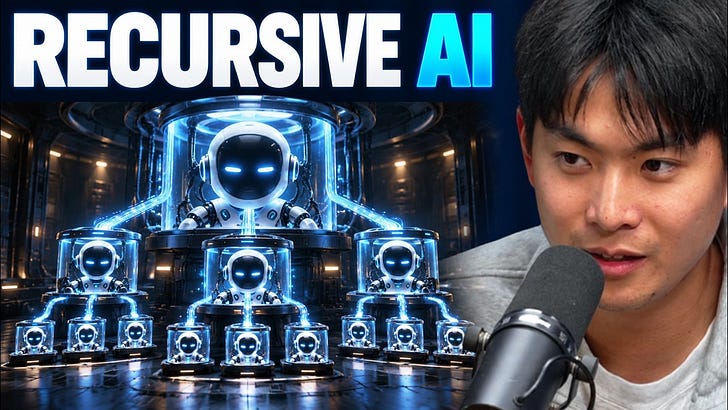

Recursive Language Models (RLMs) and advanced agent harness design represent a fundamental shift in AI development, moving beyond standard autoregressive decoders toward compositional systems that leverage code-based sub-agent calls. Alex Zhang, a researcher and contributor to GPU Mode, emphasizes that current AI progress often relies on "skill issues" where better harness design—rather than just raw model scaling—can unlock significant efficiency and generalization. By offloading context to persistent storage and utilizing code as a primary tool, RLMs enable models to solve complex, long-running tasks by breaking them into manageable, in-distribution sub-problems. This approach challenges the reliance on standard frontier models, suggesting that specialized, opinionated harness architectures can achieve superior performance in domains like GPU kernel optimization and automated research, providing a viable path for academic research to compete with large-scale industry labs.
Sign in to continue reading, translating and more.
Open full episode in Podwise