


Why AI Startups Will Disappear Without Compute Markets — Evan Conrad, San Francisco Compute
22 Oct 2026

We turn high signal in-person events for the top AI engineers, founders, leaders, and researchers in the world into the best free learning opportunities for millions around the world here on YouTube. Your subscribes, likes, comments, speaking, attendance, or sponsorships goes a long way toward making our biz model sustainable indefinitely. We strongly believe this industry deserves a better class of community and that we know how to do this well; we just need your support.

Cloud Managed Agents (CMA) provide a scalable, infrastructure-managed framework for building, deploying, and orchestrating AI agents. The platform abstracts complex backend requirements like sandbox management, event streaming, and scaling, allowing developers to focus on product logic. Key capabilities include multi-a...

The discussion focuses on the operational challenges of building and managing AI agents within enterprise environments. Key strategies include using CLI tools for CI/CD to update agent resources via YAML, ensuring consistent deployments across workspaces. Evaluation requires high-quality data sets and iterative testing...

Gabe Cemaj and Priyanka Phatak present a technical demonstration of a platform designed for orchestrating multi-agent AI workflows. The system utilizes an API-first architecture, enabling developers to build custom UIs and schedule recurring tasks through deployments. A core innovation is the "dreaming" feature, which ...

Building robust agentic infrastructure requires moving away from monolithic, stateful containers toward a decoupled, modular architecture. By separating the session log, the agentic harness, and the execution environment, developers can treat infrastructure components as interchangeable "cattle" rather than fragile "pe...
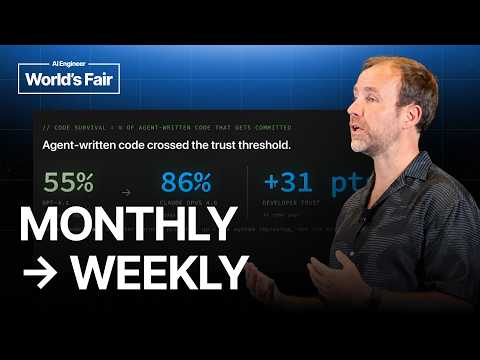
VSCode successfully transitioned from a ten-year monthly release cycle to a weekly cadence by integrating AI agents throughout the software development lifecycle. This evolution prioritizes systemic efficiency over simple code generation, evidenced by AI-written code survival rates climbing from 55% to 86%. Key technic...

Traditional "golden signals"—latency, error, traffic, and saturation—are insufficient for evaluating the health of generative AI applications. Unlike deterministic software, GenAI requires a multi-dimensional monitoring strategy focused on cost, safety, and output quality. Financial stability depends on granular tracki...

AI agents often operate with excessive privileges, posing significant security risks to local environments. Demonstrating this vulnerability, researchers can easily extract sensitive browser history and financial data from desktop AI applications using simple prompts. To mitigate these threats, Docker’s SBX project uti...

Self-driving production addresses the growing complexity in software engineering caused by the rapid adoption of AI coding agents. While these tools accelerate development, they inadvertently shift the burden toward troubleshooting, with engineers spending significant time resolving issues in increasingly complex envir...

Scaling synthetic data to trillion-token levels requires overcoming significant infrastructure bottlenecks to avoid idle compute and inefficient workflows. By utilizing a "Beyond Web" rephrasing recipe, models can achieve superior accuracy with fewer tokens, effectively bypassing the limitations of web-scale data. Crit...

AI-generated code now outpaces human review capacity, creating a critical bottleneck where engineering teams must trade velocity for software stability. Meticulous addresses this by providing exhaustive front-end verification through a deterministic browser engine that records and replays thousands of user workflows. B...

Deploying browser agents in production requires shifting from simple, single-run demos to robust, scalable systems that manage continuous cost and risk accumulation. Because browser agents lack partial credit—value is only realized upon full task completion—engineers must prioritize performance, cost, and maintainabili...

The Kimchi coding platform addresses the rising costs of LLM token usage by implementing an autonomous harness that dynamically selects the most cost-effective model for specific tasks without compromising quality. By utilizing an automated, multi-model approach, the platform achieves significant savings, with internal...

Coding agents require semantic search engines to overcome LLM knowledge cutoffs, which typically leave models six months behind current repository changes. By providing context-rich, token-efficient snippets rather than full web pages, Exa enables agents to perform accurate code reviews and dependency migrations. This ...

The Model Context Protocol (MCP) faces significant criticism for causing context bloat and inefficiency, yet these issues stem from poor implementation rather than the protocol’s design. Effective agent-tool interaction requires strategies like progressive tool discovery and "CodeMode," where models treat tools as exec...

Superintelligence is transitioning from a rented, cloud-based utility to a personalized, locally-owned asset. While current AI models function as brilliant strangers that reset after every session, integrating persistent, local memory transforms these tools into a "second mind" that compounds knowledge over time. By ut...

AI integration into software development workflows yields modest productivity gains, with median velocity increases of 7.7% rather than the anticipated 10x leaps. While deployment frequency rises, organizations face increased volatility in change failure rates and a growing psychological gap where developers report hig...

The Chief AI Officer role functions as a fluid, context-dependent position shaped by a company’s specific AI maturity and business objectives. Success in this capacity requires balancing three distinct focus areas: the scientist, who explores and experiments with emerging technology; the architect, who embeds AI into p...

The rapid adoption of AI agents has created a significant bottleneck in software development: while code generation speed has surged, the capacity for human code review remains stagnant. Research indicates that developers using autonomous agents write significantly more code, yet actual software shipping rates lag behi...

The future of software development centers on autonomous AI-to-AI communication, where agents operate as a distributed system rather than isolated, human-prompted sessions. Current agentic workflows suffer from fragmentation, requiring developers to act as manual routers between stateless processes. Solving this requir...
Follow this podcast in Podwise
Sign in to get AI summaries, transcripts and mind maps for any episode, including new ones.