


5 Thinking Habits That Make You Look Smarter
28 Aug 2026
14m

Hey there! I'm Justin Sung, a learning coach and former medical doctor with over a decade of experience teaching people to learn efficiently. On my channel, I help professionals and students learn how to learn. I do this by sharing evidence-based learning strategies and self-management methods that I've tried and tested for thousands of students and busy professionals. I'm also the Co-Founder and Head of Learning at iCanStudy, where we've helped over 30,000 learners around the world to master new knowledge and skills in half the time.

Learning faster requires shifting focus from raw reading speed to "time to outcome," prioritizing mastery over volume. Two primary methods facilitate this: increasing the frequency of prediction errors and utilizing multi-pass encoding. By predicting content before engagement, learners create "aha" moments that strengt...


Effective learning relies on developing "deep processing" rather than imitating the surface-level habits of high performers. Because top achievers often possess innate or early-developed cognitive networks that allow them to synthesize information automatically, copying their study methods—such as reading textbooks or ...
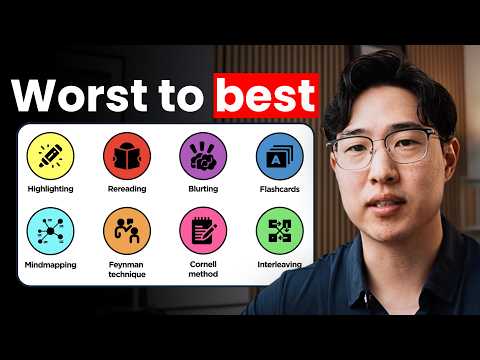
Effective learning requires active cognitive engagement rather than passive repetition. Common strategies like highlighting and re-reading are largely ineffective because they create an illusion of familiarity without fostering deep schema building or complex problem-solving skills. In contrast, methods that force the ...

Learning efficiency relies on a structured, 14-step methodology that prioritizes deep retention over superficial speed. Effective learning requires clear, goal-directed planning and priming, where the focus remains on grasping the "gist" of information to create essential memory anchors. Rather than relying on rote mem...




Mind mapping is a powerful cognitive tool that often fails because it forcibly disrupts the "illusion of fluency"—the false sense of progress derived from linear note-taking. While traditional methods provide immediate signals of familiarity, they often fail to build deep, integrated knowledge. Effective learning requi...

Productivity centers on achieving personally meaningful goals rather than constant busyness or rigid discipline. A sustainable system requires four core components: defining clear, goal-oriented outcomes; "flow matching" tasks to cognitive energy peaks to avoid diminishing returns; creating "scripted actions" to handle...

Learning from paper often yields superior comprehension compared to screens, though this advantage stems from cognitive habits rather than the medium itself. Research identifies four primary drivers for this disparity: the absence of digital distractions, the preservation of spatial memory anchors, optimized line lengt...

Career competitiveness in the era of AI requires shifting from lower-order, isolated skill acquisition to higher-order thinking. While AI rapidly automates routine tasks and memorization, it struggles with deeply contextual, multi-factorial problem-solving. Professionals must prioritize developing the ability to see co...

Common learning advice often hinders progress by prioritizing comfort over cognitive development. Instead of repeatedly reviewing material, learners should zoom out to build context and schemas, which allows new information to connect to existing knowledge. Rather than learning at a self-determined pace, effective skil...

Overcoming cognitive overwhelm requires shifting from reactive, high-pressure decision-making to structured, iterative thinking. Rather than cramming deep analysis into short windows, dedicate uninterrupted time to externalize thoughts on paper, which optimizes the brain's limited working memory. Avoid the trap of "for...

"Deep processing tanking" explains why naturally high-performing learners often hit a performance plateau when transitioning to more demanding environments like university or professional careers. These individuals typically rely on innate deep-thinking abilities—characterized by active evaluation, constant comparison,...

Exhaustion often stems from a misunderstanding of rest, which is distinct from true recovery. While low-effort activities like scrolling social media provide temporary distraction, they fail to clear accumulated cognitive neurotransmitters, leading to "low-effort agitation." Effective recovery requires psychological de...


Memory is not an innate capacity but a skill defined by how effectively one handles information. The brain’s working memory acts as a 15-to-30-second "workbench" where raw data must be actively manipulated to be successfully encoded into long-term storage. Rather than relying on passive repetition, learning requires de...
Follow this podcast in Podwise
Sign in to get AI summaries, transcripts and mind maps for any episode, including new ones.