Institute for Pure & Applied Mathematics (IPAM)
The Institute for Pure and Applied Mathematics (IPAM) is a National Science Foundation Math Institute at the University of California, Los Angeles (UCLA) that fosters the interaction of mathematics with a broad range of science and technology, builds new interdisciplinary research communities, promotes mathematical innovation, and engages and transforms the world through mathematics. IPAM fulfills its mission through workshops and programs that connect mathematics and other disciplines or multiple areas of mathematics. These activities bring in thousands of visitors annually from academia, government, and industry. The NSF has encouraged IPAM to make the scientific presentations of our speakers available to a wider audience. While this YouTube channel contains many of our most popular videos, our full video archive is available at www.ipam.ucla.edu/videos.
Episodes


Osbert Bastani - Interpretable Machine Learning via Program Synthesis - IPAM at UCLA

Bin Yu - Interpreting Deep Neural Networks towards Trustworthiness - IPAM at UCLA

Jaesik Choi - Explainable AI to Analyze Internal Decision Mechanism of Deep Neural Networks

Xiao Fu - Multiview and Self-Supervised Representation Learning: Nonlinear Mixture Identification

Bolei Zhou - From Network Dissection to Policy Dissection: Emergent Concepts in Deep Representations

Klaus Robert Muller - AI for the Sciences: Recent Developments for XAI - IPAM at UCLA

Jamie Haddock - Hierarchical and neural nonnegative tensor factorizations - IPAM at UCLA

Kevin Kelly - Machine Learning Enhanced Compressive Hyperspectral Imaging - IPAM at UCLA

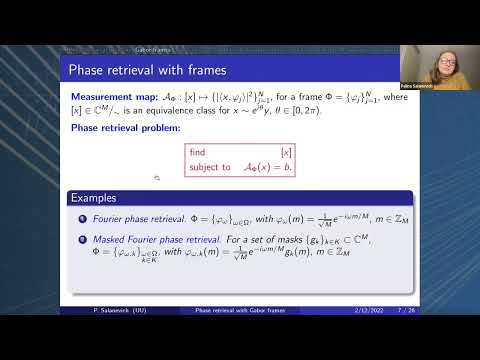
Palina Salanevich - STFT Phase retrieval: robustness and generative priors - IPAM at UCLA

Reinhard Heckel - The role of data and models for deep-learning based image reconstruction

Mark Iwen - Accurate Recovery of Compactly Supported Smooth Functions from Spectrogram Measurements

Elizaveta Rebrova - Low-rank tensor recovery from memory-efficient measurements - IPAM at UCLA

Mary Scott - Supervised and Unsupervised approaches for Electron Microscopy Data Analysis

Mahdi Soltanolkotabi - Medical image reconstruction via deep learning: architectures, data reduction

Ben Recht - Splitting the difference between deep and shallow solutions of inverse problems

Juan Carlos Idrobo - Quantum Phenomena & Electron Microscopy: New Possibilities & Limitations

Sarah Haigh - Probing atomic behaviour in liquids with STEM : opportunities for machine learning

Paul Hand - Signal Recovery with Generative Priors - IPAM at UCLA

Robert Wolkow - Atom-Defined Devices, Ultra-Fast Classical Devices, and Diverse Quantum Devices
Follow this podcast in Podwise
Sign in to get AI summaries, transcripts and mind maps for any episode, including new ones.