Institute for Pure & Applied Mathematics (IPAM)
The Institute for Pure and Applied Mathematics (IPAM) is a National Science Foundation Math Institute at the University of California, Los Angeles (UCLA) that fosters the interaction of mathematics with a broad range of science and technology, builds new interdisciplinary research communities, promotes mathematical innovation, and engages and transforms the world through mathematics. IPAM fulfills its mission through workshops and programs that connect mathematics and other disciplines or multiple areas of mathematics. These activities bring in thousands of visitors annually from academia, government, and industry. The NSF has encouraged IPAM to make the scientific presentations of our speakers available to a wider audience. While this YouTube channel contains many of our most popular videos, our full video archive is available at www.ipam.ucla.edu/videos.
Episodes


Read Montague: "Invasive approaches in the future of Computational Psychiatry"

Emery Brown: "Deciphering the Dynamics of the Unconscious Brain Under General Anesthesia"

Daniel Rueckert: "Deep learning and shape modelling for medical image reconstruction, segmentati..."

Marc Niethammer: "Deep Learning for Medical Image Registration"

Ben Glocker: "Causality matters in medical imaging"

Tom Vercauteren: "Flexible machine learning approaches for computer-assisted surgery"

Ender Konukoglu: "On Bayesian models with networks for reconstruction and detection"

Florian Knoll: "MR image acquisition and reconstruction in the era of deep learning"

Pablo Suárez-Serrato: "Quantifying the Topology of Coma"

Bao Wang: "Momentum in Stochastic Gradient Descent and Deep Neural Nets"

Jamie Haddock: "Scaling the Hierarchical Topic Modeling Mountain: Neural NMF and Iterative Proje..."

Ivana Išgum: "Deep learning for cardiovascular image analysis"

Jong Chul Ye: "Geometric Understanding of Supervised and Unsupervised Deep Learning for Biomedic..."

Gitta Kutyniok: "Deep Learning and Modeling: Taking the Best out of Both Worlds"

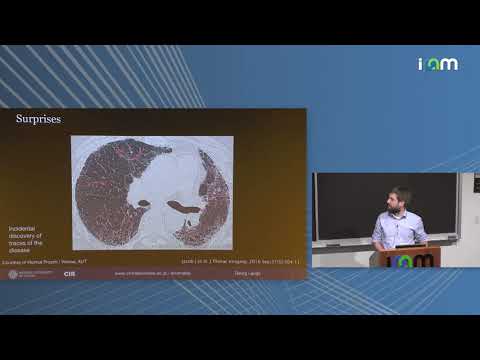
Georg Langs: "Deep learning for anomaly detection: expanding our marker vocabulary"

Dosik Hwang: "Deep Learning-based MR Image Reconstruction and Contrast Conversion"

Ulugbek Kamilov: "Computational Imaging: Reconciling Models and Learning"

Stanley Osher: "Trustworthy deep learning"

Michael Unser: "Splines and imaging: From compressed sensing to deep neural networks"
Follow this podcast in Podwise
Sign in to get AI summaries, transcripts and mind maps for any episode, including new ones.