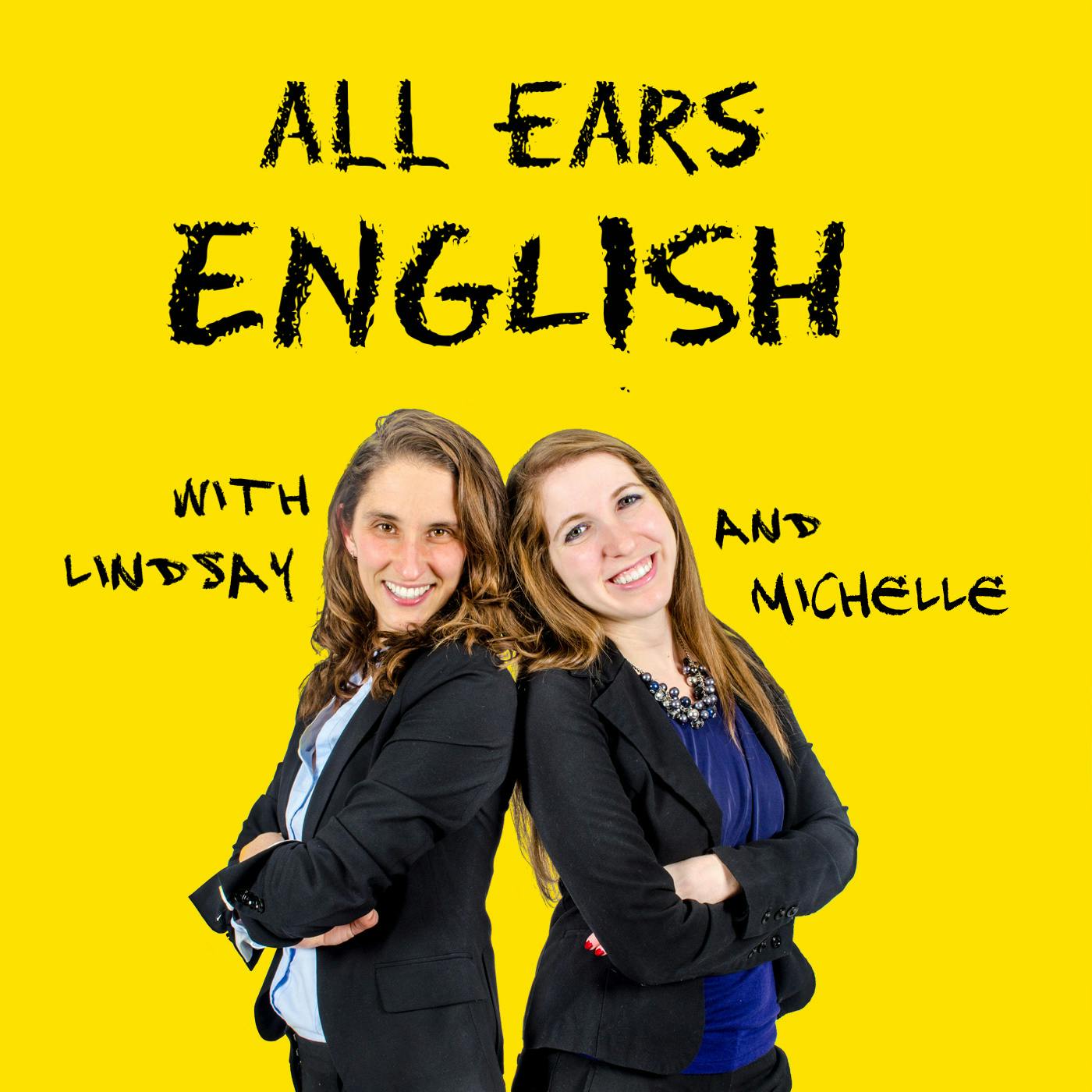
Podcast cover
Lindsay McMahon and Michelle Kaplan · Education

All Ears English Podcast

Are you looking for a new and fun way to learn American English? Come hang out with Lindsay and Michelle from Boston and New York City and have fun while you improve your English listening skills! We are an English as a Second Language (ESL) podcast for intermediate to advanced English learners around the world. We will show you how to use everyday English vocabulary and natural idioms, expressions, and phrasal verbs and how to make small talk in American English. We will also give you special tips on American culture, customs, etiquette, and how to speak with Americans as well as conversation and commentary on study tips, business English, life in America and Boston and New York, how to apply to university in the US, dating, travel, food and more. You'll get TOEFL, IELTS, and TOEIC help also from The Examiner of Excellence, Jessica Beck. This podcast is for adult students who are professionals and university students as well as ESL teachers. Join the community to learn to speak American English like a native! Connection NOT Perfection!


Episodes

Episode cover

AEE 2621: Vocabulary You Should Not Put Behind You

21 May 2026
15m
AI processed

Healing from disappointment and moving forward requires specific vocabulary to express emotional recovery. Phrases like "get past it," "move on," "let go," and "put it behind you" serve as essential tools for navigating setbacks, ranging from minor inconveniences to significant life changes like breakups. While "get pa...

Episode cover

AEE 2620: Debunk and Connect with Lindsay and Michelle

20 May 2026
17m
AI processed

The term "debunk" signifies the act of proving that a widely held belief, theory, or claim is false. Often applied to scientific studies, news reports, and historical myths, it serves as a critical tool for navigating the modern era of misinformation and rapidly evolving digital content. While nutrition research freque...

Episode cover

AEE 2619: Do You Think Two is a Party and Three is a Crowd?

19 May 2026
15m
AI processed

Idioms and expressions centered on the number three provide essential tools for natural English communication. Social dynamics often hinge on the concept that "two is a party, three is a crowd," reflecting common feelings of exclusion or jealousy in group settings. Beyond social interactions, the phrase "three strikes ...

Episode cover

AEE 2618: Should You Call a Man Sassy? Gendered Words in English

18 May 2026
22m
AI processed

The word "sassy" carries significant nuance and gendered implications in English, often functioning as a descriptor for spirited or bold behavior while occasionally serving as an insult depending on context and tone. While traditionally associated with women, the term can apply to men, particularly those comfortable wi...

Episode cover

AEE: Jeopardize, Endanger, Compromise…Oh My!

16 May 2026
17m
AI processed

Vocabulary nuances regarding risk-related terms—jeopardize, endanger, imperil, and compromise—require careful distinction based on context and formality. "Jeopardize" and "compromise" function well in everyday professional and personal settings, such as discussing potential career setbacks or the loss of trust. Convers...

Episode cover

AEE 2617: From a Distance? Or in the Distance? How to Talk About Concerts, Sporting Events, and More

14 May 2026
19m
AI processed

The distinction between "at/from a distance" and "in the distance" hinges on whether distance functions as a conceptual measurement or a specific location. "At a distance" and "from a distance" describe vague, arbitrary amounts of space, often highlighting a speaker's perspective or a boundary between entities. For ins...

Episode cover

AEE 2616: That’s on Me! Admitting Mistakes Without Making It Awkward

13 May 2026
15m
AI processed

Admitting mistakes with calm accountability is essential for maintaining strong relationships and avoiding unnecessary conflict. Using phrases like "that's on me" signals self-awareness and maturity, making it an effective tool in both professional and personal environments. While "my bad" serves as a more casual, info...

Episode cover

AEE 2615: The Math Isn't Mathing!

12 May 2026
17m
AI processed

"The math isn't mathing" serves as a playful, modern idiom to express that a situation lacks logic or fails to align with expectations. While grammatically unconventional, the phrase effectively builds connection by injecting personality into everyday conversations. It functions as a versatile alternative to standard e...

Episode cover

AEE 2614: Don't Turn Your Back on the Weather as a Great Connection Topic

11 May 2026
21m
AI processed

Weather serves as a powerful tool for building connections and initiating conversations in English, despite its reputation as mundane small talk. Precision in vocabulary enhances communication; for instance, "cloudy" implies intermittent breaks in the sky, while "overcast" suggests a uniform, gray blanket. Similarly, "...

Episode cover

AEE: Close to or Closed to? Can You Hear the Difference?

09 May 2026
16m
AI processed

Distinguishing between "close to" and "closed to" requires attention to pronunciation, word length, and context. "Close to" signifies physical proximity or emotional connection, characterized by a shorter duration and a soft "s" sound. In contrast, "closed to" indicates inaccessibility or being shut off, often involvin...

Episode cover

AEE 2613: At the End of Your Rope? 5 Ways to Express Frustration in English

07 May 2026
17m
AI processed

Expressing frustration effectively in English requires moving beyond basic grammar to using natural, idiomatic expressions that convey clear emotional boundaries. Phrases like "I'm done" or "I'm so done" signal a definitive limit, often used when canceling services or ending unproductive interactions. "I'm fed up" and ...

Episode cover

AEE 2612: I'm Up for It If You Are! How to Recruit Friends to Join You at Social Events

06 May 2026
14m
AI processed

Recruiting friends to attend social events requires clear communication to establish a sense of solidarity and shared commitment. Using idiomatic phrases like "I'll go if you go" or "I'm in if you're in" creates a social contract that makes attendance more appealing, especially when facing financial constraints or hesi...

Episode cover

AEE 2611: How to Direct Someone's Attention With Enthusiasm

05 May 2026
14m
AI processed

Directing attention to specific objects or events requires enthusiasm to foster genuine connection. Phrases like "check it out" and "check this out" serve as effective tools for drawing someone's focus to something visual or noteworthy, such as a new purchase, a discovery, or a unique find. These expressions signal con...

Episode cover

AEE 2610: Walk or Work? 3 Pronunciation Mistakes to Avoid With Dave Nicholls

04 May 2026
21m
AI processed

English teacher Dave Nicholls addresses three common pronunciation challenges that often hinder clarity for language learners. The discussion centers on distinguishing between "walk," "work," and the noun "wok," noting that while American English emphasizes a distinct "r" sound in "work," British English maintains clos...

Episode cover

AEE: Casual or Fine Dining? Restaurant English Explained

02 May 2026
23m
AI processed

Distinguishing between casual and fine dining is essential for social navigation and understanding cultural expectations in American restaurants. Casual dining encompasses relaxed environments like diners, brew pubs, and fast-casual spots where dress codes are informal and service is efficient. Conversely, fine dining ...

Episode cover

AEE 2609: English Grammar to Show Your Nostalgia

30 Apr 2026
17m
AI processed

Expressing nostalgia in English relies on specific present perfect constructions that bridge the gap between past experiences and current perspectives. Phrases such as "I haven't [verb] in so long" or "It's been ages" effectively convey the passage of time while inviting deeper connection through shared memories. These...

Episode cover

AEE 2608: How to Sound Smart When You Comment on Art with the Word Cascade

29 Apr 2026
21m
AI processed

The word "cascade" functions as a sophisticated tool for describing both literal downward flows and figurative chain reactions. Literally, it captures the movement of water, hair, or light, providing a poetic alternative to common verbs like "flow" or "pour." Figuratively, it denotes a series of interconnected events o...

Episode cover

AEE 2607: Connection 101

28 Apr 2026
20m
AI processed

The phrase "[Subject] 101" functions as a versatile, idiomatic expression for identifying foundational knowledge or introductory skills beyond its academic origins. Originally denoting entry-level college courses, the construction now serves as a shorthand for basic proficiency in everyday activities like cooking, hair...

Episode cover

AEE 2606: Scratch, Ding, or Dent? How to Talk About Car Damage in English

27 Apr 2026
20m
AI processed

Car damage terminology requires specific vocabulary to accurately convey the severity of an incident. A "ding" refers to minor, often superficial damage, while a "scuff" typically involves paint marks that can be wiped away. Deeper impacts that alter the metal structure are classified as "dents." Using the term "fender...

Episode cover

AEE: Is All Ears English Your One in a Million?

25 Apr 2026
19m
AI processed

Idioms involving the number "one" frequently appear in English to express priorities, uniqueness, and finality. "The one and only" serves to elevate someone's status during introductions, while describing something as "number one" establishes it as a primary priority. The term "one-hit wonder" characterizes artists or ...

Page 6

Follow this podcast in Podwise

Sign in to get AI summaries, transcripts and mind maps for any episode, including new ones.

Open in Podwise