

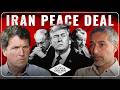
Neocons Move to Merge CIA & Mossad While Netanyahu Desperately Begs Trump Not to Leave His Side

Tucker Carlson
The potential U.S.-Iran deal represents a significant shift in Middle Eastern geopolitics, centering on the reopening of the Strait of Hormuz and limited sanctions relief. This fragile agreement faces constant sabotage from Israeli hardliners, who view the resolution of U.S.-Iran tensions as an existential threat to their regional military hegemony. Iran’s "forward defense" strategy, which leverages regional proxies to deter direct conflict, has forced a reevaluation of traditional power dynamics. Meanwhile, U.S. foreign policy remains heavily influenced by a bipartisan commitment to unconditional support for Israel, often at the expense of American national interests and economic stability. This reliance on a "special relationship" has trapped the United States in a cycle of endless regional wars, while the domestic political system, captured by foreign donors and opaque think-tank funding, continues to prioritize these external commitments over the needs of the American public.
Sign in to continue reading, translating and more.
Open full episode in Podwise