

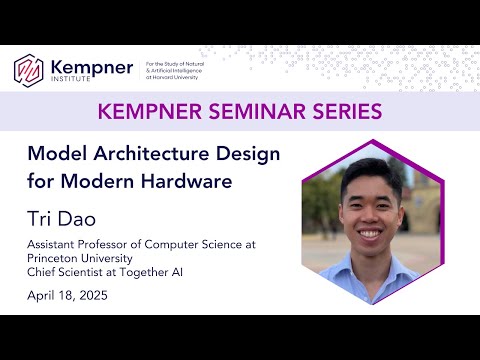
Model Architecture Design for Modern Hardware with Tri Dao

Kempner Institute at Harvard University
Optimizing AI models for modern hardware requires balancing algorithmic efficiency with hardware-specific constraints to maximize intelligence per dollar. State space models, such as Mamba, achieve linear scaling by exploiting memory hierarchies, specifically by keeping states in SRAM to avoid expensive high-bandwidth memory writes. While transformers excel at information retrieval, hybrid architectures—integrating Mamba layers with a small percentage of attention layers—offer superior performance and efficiency for long-context tasks. Inference-first design strategies, including Group Query Attention and Multi-Latent Attention, significantly increase arithmetic intensity, allowing models to reach compute-bound performance during decoding. Furthermore, distilling knowledge from pre-trained transformers into these efficient architectures enables substantial improvements in inference throughput and test-time compute scaling, providing a viable path for deploying high-performance models on resource-constrained hardware.
Sign in to continue reading, translating and more.
Open full episode in Podwise