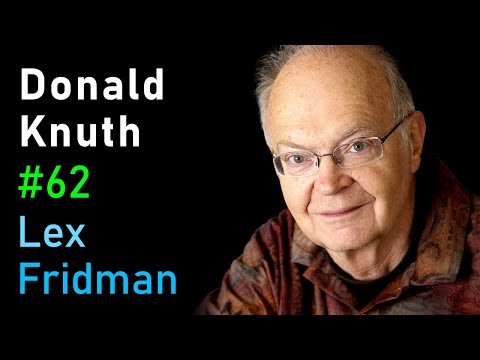
Donald Knuth, a highly influential computer scientist, reflects on his career, computational thinking, and the art of programming. He describes "geek" thinking as the ability to fluidly jump between levels of abstraction and handle non-uniformity in problem-solving, citing Alan Turing as the quintessential geek. Knuth summarizes his multi-volume work, "The Art of Computer Programming," emphasizing the importance of algorithm analysis and combinatorial methods. He also touches on his creation of the TeX typesetting system and his forays into religion and music. The conversation explores the balance between formal and informal approaches to programming, the role of randomness, and the limits of human understanding.
Outlines
Part 1: Early Life, Computing History, and the Geek Mindset
Part 2: Literate Programming and Literary Influences
Part 3: Talent, Education, and Neural Networks
Part 4: The Art of Computer Programming (TAOCP)
Part 5: Writing Process, Craft, and Creativity
Part 6: Algorithms, Logic, and Complexity
Part 7: AI, Cognition, and Philosophy
Part 8: Religion, Mortality, and Life Lessons
Part 9: Typography, Infinity, and Final Wisdom
Sign in to continue reading, translating and more.