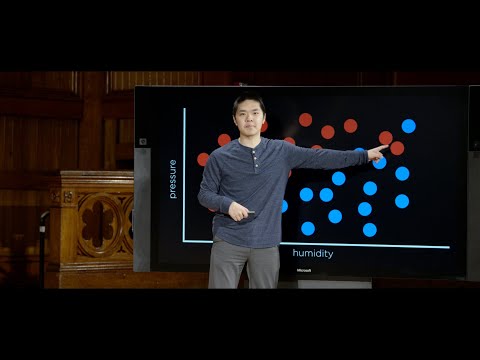
The lecture introduces supervised machine learning, contrasting it with traditional AI that relies on explicit instructions. It defines supervised learning as training a computer to map inputs to discrete categories, using classification as an example, such as predicting whether a banknote is authentic or counterfeit based on input data. The lecture then discusses nearest neighbor classification, k-nearest neighbors, and linear regression, including the perceptron learning rule, to find decision boundaries. It also covers regression for predicting continuous values, like the impact of advertising spend on sales, and addresses evaluating models through loss functions (0-1, L1, L2) and avoiding overfitting via regularization and cross-validation. The lecture concludes with reinforcement learning, Q-learning, and unsupervised learning with k-means clustering.
Outlines
Part 1: Introduction to Machine Learning
Part 2: Supervised Learning and Classification
Part 3: Linear Models and Optimization
Part 4: Regression and Model Evaluation
Part 5: Generalization and Practical Implementation
Part 6: Reinforcement Learning
Part 7: Unsupervised Learning and Conclusion
Sign in to continue reading, translating and more.