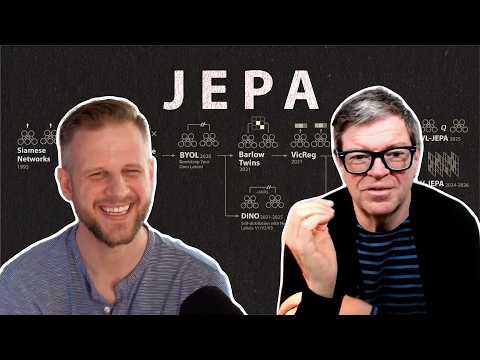

JEPA (Joint Embedding Predictive Architecture) offers a non-generative alternative to large language models by focusing on learning internal representations of the world rather than predicting raw outputs. Unlike LLMs, which rely on next-token prediction, JEPA utilizes encoders to map inputs to embedding vectors, sidestepping the "blurry" output issues inherent in generative video models. Techniques like Barlow Twins and DINO address the challenge of representation collapse, allowing models to extract meaningful features without human-labeled data. By integrating world models, AI agents can predict the consequences of their actions, facilitating planning and safety in complex environments. This approach shifts the focus from mere autoregressive text generation to building autonomous systems capable of reasoning and understanding physical reality, representing a critical step toward achieving human-level intelligence.
Sign in to continue reading, translating and more.
Open full episode in Podwise