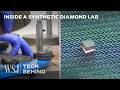
Synthetic diamond production has evolved beyond jewelry into a critical industrial technology driven by two primary manufacturing methods: High-Pressure High-Temperature (HPHT) and Chemical Vapor Deposition (CVD). While HPHT mimics geological processes to create industrial cutting tools, CVD allows for atomic-level precision essential for high-tech optics and quantum applications. Experts at Element Six demonstrate that by intentionally engineering "defects" through doping—such as the nitrogen-vacancy defect that turns diamonds pink—scientists can transform the material into highly sensitive quantum sensors capable of detecting minute changes in magnetic and electric fields. Despite diamond's superlative properties in heat dissipation and voltage resistance, the industry faces significant hurdles in scaling due to high production costs compared to silicon. Future growth depends on integrating these advanced materials into mass-market semiconductors and quantum computing systems over the next decade.
Sign in to continue reading, translating and more.
Continue